Finishing cancer treatment and entering remission can bring significant relief, but it does not always eliminate the financial challenges associated with a cancer diagnosis. Medical bills, reduced income, and ongoing healthcare expenses may continue long after treatment ends. If you’re wondering can you sell your life insurance policy if your cancer is in remission?, the answer is yes, in some circumstances. Remission does not automatically disqualify you from selling a policy, although your medical history, current health, and life expectancy can affect eligibility and the amount you may receive.
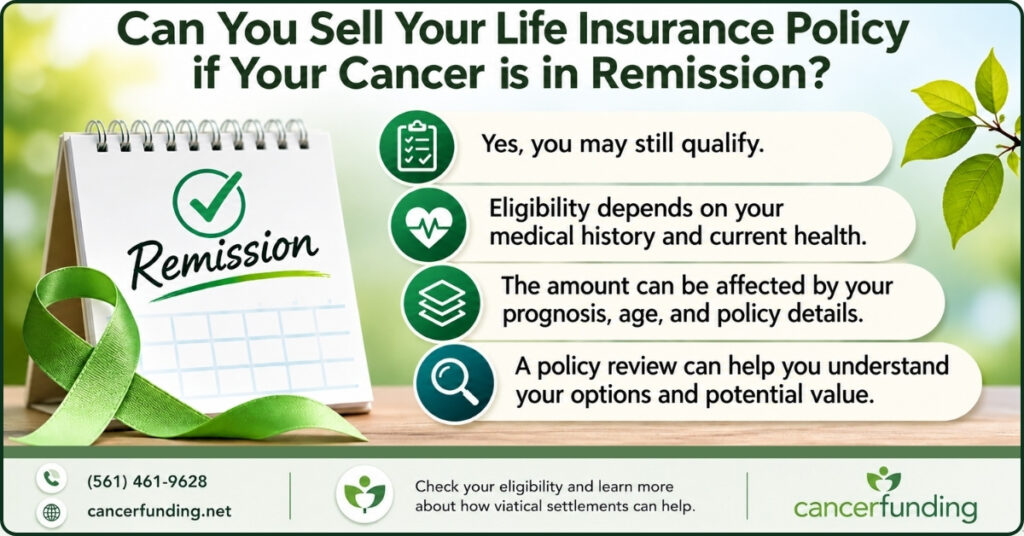
Life insurance settlements are evaluated using several factors, including the insured person’s health and the financial characteristics of the policy. Understanding how remission affects these evaluations can help you determine whether your coverage may have value beyond its cash surrender value.
Can You Qualify for a Life Settlement While in Remission?
Individuals whose cancer is in remission may qualify to sell their life insurance policies, depending on their medical circumstances and the type of coverage they own. A life settlement involves selling an existing policy to a third-party purchaser in exchange for a lump-sum payment. The purchaser generally assumes responsibility for future premiums and receives the death benefit when the insured dies.
Although viatical settlements are associated with individuals facing serious or terminal illnesses, traditional life settlements may also be available to older policy owners who do not meet viatical settlement criteria. Someone in remission may qualify for either type of transaction, depending on their health, life expectancy, policy characteristics, and applicable requirements. Eligibility is based on an individual evaluation rather than whether cancer treatment is currently underway.
How Does Cancer Remission Affect Life Settlement Eligibility?
Remission means that the signs and symptoms of cancer have decreased or disappeared, but it does not necessarily mean the disease has been permanently eliminated. When evaluating a policy, purchasers consider the insured person’s original diagnosis, cancer stage, treatment history, current prognosis, and overall health.
The length of remission can also be important. Someone who recently completed treatment may have a different medical outlook than someone who has remained cancer-free for several years. Depending on the type of cancer, longer periods without recurrence may be associated with improved survival expectations.
Because purchasers consider how long they may need to maintain a policy before receiving its death benefit, changes in estimated life expectancy can influence settlement value. A longer life expectancy generally means more future premium payments, potentially reducing the amount a purchaser is willing to offer. However, remission does not automatically make a policy ineligible, particularly when other medical conditions or age-related factors are present.
Can You Sell Your Policy if Your Cancer Is Considered Cured?
Even if your oncologist considers your cancer cured or your risk of recurrence is low, you may still qualify for a traditional life settlement. Traditional settlements are not limited to individuals with cancer or other serious illnesses. Older policy owners may qualify based on their age, policy characteristics, and purchaser requirements, even when they are relatively healthy.
For example, an older individual who has been cancer-free for several years may qualify because of their age and the financial characteristics of their coverage rather than their previous diagnosis. Certain convertible term life insurance policies may also qualify for settlement consideration, including policies owned by individuals who are otherwise healthy.
Will Your Life Insurance Policy Be Worth Less During Remission?
A policy’s settlement value may decrease when the insured person’s prognosis improves, but this is not always the case. Purchasers evaluate several factors, including the death benefit, expected future premiums, estimated life expectancy, and policy provisions. Two people with identical death benefits may receive different offers because their medical circumstances or premium requirements differ.
An improvement in health may increase the number of years a purchaser expects to maintain coverage, potentially reducing the settlement amount. However, a policy with favorable premium requirements and a substantial death benefit may still have meaningful value even when the insured person’s cancer is in remission.
What Medical Information Is Needed for a Settlement Evaluation?
Medical underwriting is an important part of determining whether a policy qualifies for a settlement. For someone with a history of cancer, the evaluation may include records from the original diagnosis through the most recent follow-up appointments. Pathology reports, treatment summaries, imaging results, oncology notes, and documentation of remission may all be relevant.
Recent medical records are particularly useful because they help establish how the insured person’s condition has changed since treatment ended. They may also identify ongoing complications or other health conditions that affect the evaluation. With your authorization, a settlement provider can generally request the necessary records directly from your healthcare providers.
Should You Wait to Sell Your Policy Until After Remission?
Waiting until cancer treatment ends or remission is established may affect the amount you could receive from a life settlement. Because settlement values are influenced by medical circumstances and estimated life expectancy, an improved prognosis may result in a lower offer. However, eligibility and settlement value depend on several factors, so the effect of remission varies from person to person.
If you are currently undergoing treatment, you may already qualify for a settlement. If your cancer is in remission, your policy may still be eligible, particularly when other medical or age-related factors are present. An evaluation can help establish whether your policy qualifies under your current circumstances.
How Can You Find Out if Your Policy Qualifies?
The first step is to review the type of coverage you own, its death benefit, and any available cash surrender value. Both permanent life insurance and certain term policies may qualify for settlement consideration. A licensed life settlement provider can review the policy’s financial characteristics and arrange medical underwriting to determine whether a purchaser may be interested.
Even if your cancer is in complete remission, you should not assume your policy has no settlement value. An initial evaluation does not obligate you to sell your coverage, but it can help you understand whether a settlement may be available and what your policy could potentially be worth.
To learn if you may qualify for a viatical settlement to help with expenses, please reach out to Settlement Group, a licensed life settlement provider, at 754-296-9034, email inquiries@settlementgroup.io, or visit settlementgroup.io.