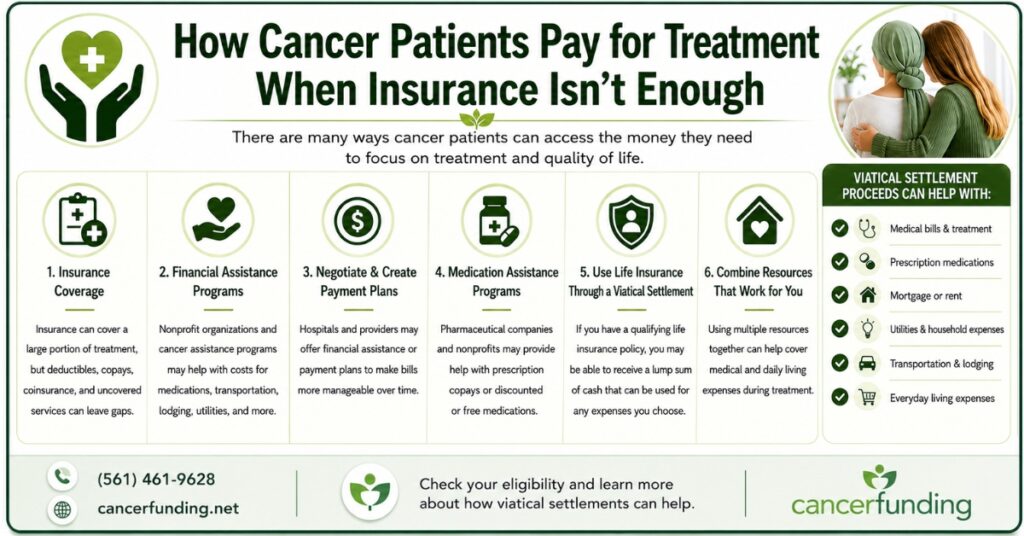
Health insurance can cover a significant portion of cancer treatment, but it does not always cover everything. How cancer patients pay for treatment when insurance isn’t enough often depends on a combination of financial assistance programs, payment arrangements, personal resources, and, for those who qualify, the value of an existing life insurance policy. Understanding the different sources of financial help available can make it easier to manage treatment expenses while continuing to cover everyday living costs.
Why Does Cancer Treatment Cost So Much Even with Insurance?
Having health insurance does not necessarily protect patients from substantial out-of-pocket costs. Deductibles, copayments, coinsurance, prescription costs, and services that are not fully covered can add up quickly.
Cancer can also create expenses that have nothing to do with a hospital bill. Depending on the circumstances, patients may face costs for transportation to appointments, lodging near a treatment center, childcare, home care, special equipment, or modifications to their homes.
At the same time, cancer may affect a person’s ability to work. A patient or family caregiver may need to reduce work hours or take extended time away from a job. That can create a difficult situation where household income decreases just as expenses increase.
What Financial Assistance Is Available for Cancer Patients?
Numerous nonprofit organizations and cancer assistance programs provide financial help to qualifying patients. The type and amount of assistance available varies considerably by organization.
Programs may help with expenses such as:
- Prescription medications
- Insurance premiums and copayments
- Transportation to treatment
- Lodging
- Food and household expenses
- Childcare
- Utility bills
Some programs are limited to people with particular types of cancer, income levels, insurance coverage, or geographic locations. Funding may also be limited or available only during certain periods.
Patients can ask their hospital or cancer treatment center whether a social worker, patient navigator, or financial counselor can help identify programs for which they may qualify.
Can You Negotiate Cancer Treatment Bills?
It may be possible to reduce or better manage certain medical bills by contacting the hospital, physician’s office, or treatment center directly.
Hospitals may have financial assistance or charity care programs for qualifying patients. Others may offer payment plans that allow a balance to be paid over time rather than all at once.
If you receive a large medical bill, it can also be worthwhile to review it carefully. Ask for an itemized bill and contact the provider if you see services or charges you do not recognize.
A payment plan does not eliminate the cost of treatment, but spreading payments over a longer period may make expenses more manageable while you explore other sources of financial assistance.
Can Pharmaceutical Assistance Programs Help with Cancer Medications?
Cancer medications can represent a significant portion of a patient’s out-of-pocket expenses. Some pharmaceutical manufacturers and nonprofit organizations have programs designed to help eligible patients access medications they otherwise could not afford.
Depending on the program, a patient assistance program may include reduced copayments, free or discounted medications, or other forms of financial support.
Eligibility requirements vary, so patients may want to ask their oncologist‘s office or treatment center whether someone can help identify assistance programs for their prescribed medications.
Can You Use Life Insurance to Pay for Cancer Treatment?
If you already own a life insurance policy, you may have ways to access its value while you are still living.
One possibility is a viatical settlement. A viatical settlement allows a person with a qualifying serious or terminal illness to sell an eligible life insurance policy for a lump-sum cash payment.
Instead of maintaining a policy solely to provide a future death benefit, a viatical settlement can allow a qualifying policy owner to access some of that value when the money may be needed most.
The proceeds can be used for any purpose, including:
- Medical bills and treatment
- Prescription medications
- Mortgage or rent payments
- Utilities and household expenses
- Transportation and lodging
- Paying down debt
- In-home assistance
- Everyday living expenses
There are generally no restrictions requiring viatical settlement proceeds to be spent specifically on medical care.
What Types of Life Insurance Can Qualify for a Viatical Settlement?
Permanent life insurance policies, including whole life and universal life, may qualify for a viatical settlement. Certain term life insurance policies can also qualify.
If a term policy includes a conversion privilege, it may be possible to convert the coverage into permanent life insurance without new medical underwriting. This can be particularly important for someone whose health has changed since purchasing the original policy.
Non-convertible term policies are more difficult to sell. However, some may still qualify in circumstances involving a terminal illness and limited life expectancy.
Eligibility and settlement value depend on the individual policy and the insured’s medical circumstances.
How Can a Viatical Settlement Help with More Than Medical Bills?
One of the advantages of a viatical settlement is that the funds are not limited to expenses directly related to cancer treatment.
For many households, the financial impact of cancer extends far beyond medical bills. A person who cannot work during treatment may still have a mortgage, utilities, groceries, car payments, and other regular expenses.
Accessing money from a life insurance policy can provide financial breathing room during this period. It can also give patients more flexibility to travel for care, pay for additional help at home, or simply spend less time worrying about how everyday bills will be paid. Typically, proceeds from viatical settlements are not subject to tax. Always consult with your trust tax professional for guidance on your specific situation.
In some cases, a retained death benefit may be available. This allows a policy owner to receive money from a settlement while preserving a portion of the policy’s death benefit for beneficiaries.
What Other Resources Can Help with Cancer Treatment Costs?
Financial assistance does not have to come from a single source. Patients may use several resources together to address different expenses.
For example, a nonprofit organization might provide transportation assistance while a hospital offers a payment plan for medical bills. A pharmaceutical assistance program could reduce medication expenses, while personal savings or viatical settlement proceeds could help with household costs.
The right combination depends on the patient’s financial situation, insurance coverage, diagnosis, available resources, and immediate needs.
How Do You Decide Which Financial Resources to Use?
Start by identifying where the largest financial gaps exist. Review what insurance is paying, what you are expected to pay yourself, and which non-medical expenses have become harder to manage because of your diagnosis.
Then explore resources based on those needs. Ask your treatment center about financial assistance programs, investigate help with medications and transportation, and review any financial assets you already have.
If you own life insurance, having the policy reviewed can also help you determine whether it may qualify for a viatical settlement. There is no obligation to sell your policy simply because you request an evaluation.
Cancer treatment can create financial challenges even for people with good health insurance. Knowing which resources are available can help you make informed decisions about how to cover treatment and household expenses while focusing more of your attention on your health.
To learn if you may qualify for a viatical settlement to help with expenses, please reach out to Settlement Group, a licensed life settlement provider at 754-296-9034, email inquiries@settlementgroup.io, or visit settlementgroup.io.