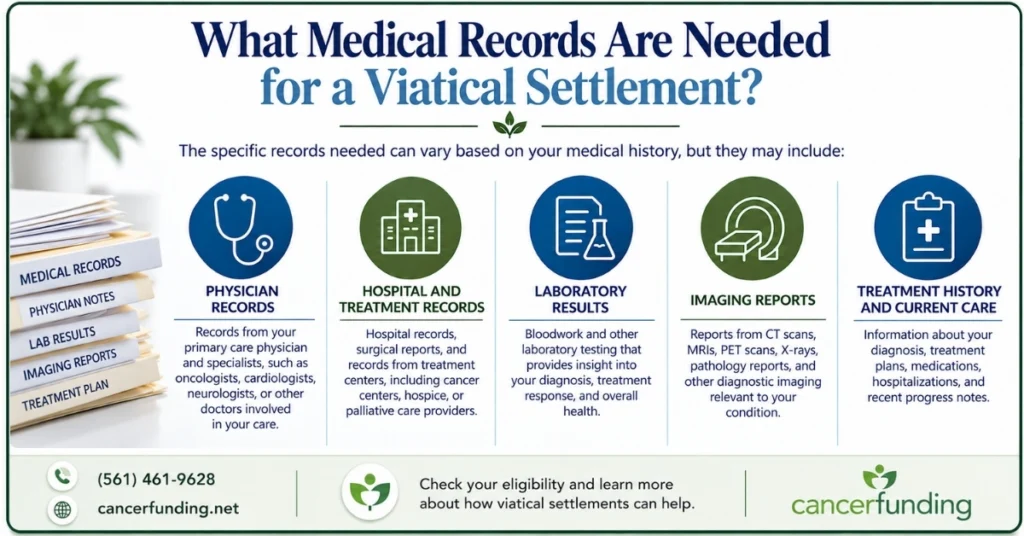
If you are considering selling your life insurance policy because of a serious illness, you may wonder, what medical records are needed for a viatical settlement? Medical records are an important part of the evaluation because they provide information about your diagnosis, treatment, overall health, and prognosis. The records needed will depend on your medical history and condition, but they may include records from your primary care physician, specialists, hospitals, treatment centers, laboratory testing, imaging, and other healthcare providers involved in your care.
Understanding which records may be requested and why can help you know what to expect during the viatical settlement process.
Why Are Medical Records Needed for a Viatical Settlement?
A viatical settlement involves purchasing a life insurance policy from someone with a qualifying illness. To evaluate the policy, the provider needs information about both the life insurance coverage and the insured’s health.
Medical records help provide a complete picture of the insured’s medical condition. They may be used to evaluate factors such as:
- Diagnosis
- Severity and progression of the illness
- Treatment history
- Current treatment
- Response to treatment
- Other medical conditions
- Overall health
- Prognosis
This information can be used in life expectancy underwriting, which estimates the insured’s anticipated life expectancy based on available medical information and actuarial data.
Life expectancy is an important factor in determining whether a policy may qualify and how much a buyer may be willing to pay for it.
Which Doctors’ Records Are Needed for a Viatical Settlement?
The records requested depend on the insured’s individual medical history.
For someone undergoing cancer treatment, for example, records may be requested from an oncologist as well as the primary care physician and other specialists involved in treatment.
Depending on the condition, records may come from:
- Primary care physicians
- Oncologists
- Cardiologists
- Neurologists
- Pulmonologists
- Surgeons
- Other specialists
- Hospitals
- Cancer or specialty treatment centers
- Hospice or palliative care providers
Not every applicant will need records from all of these sources. The goal is to obtain the records relevant to the insured’s diagnosis, treatment, and current health.
What Information in Your Medical Records Is Important?
Medical records contain much more than a diagnosis. Underwriters may review the history and progression of the illness to understand the insured’s current condition.
Relevant information may include physician notes, consultation reports, treatment plans, hospital records, pathology reports, laboratory results, imaging reports, surgical records, and information about medications.
For someone with cancer, records document the type and stage of cancer, when it was diagnosed, where it has spread, treatments that have been attempted, how the cancer has responded, and what treatment is currently planned.
For another serious illness, the relevant information will be different. The purpose is to obtain enough medical information to evaluate the insured’s overall health rather than relying on a diagnosis alone.
Are Lab Results and Imaging Reports Needed?
They may be. Laboratory testing and imaging can provide important information about the severity and progression of an illness. Depending on the insured’s condition, relevant records could include bloodwork, pathology results, CT scans, MRIs, PET scans, X-rays, or other diagnostic testing.
In many cases, the written reports associated with these tests are included in the medical records obtained from the physician or treatment facility.
You generally do not need to determine on your own which individual test results should be submitted. The records needed can be identified as part of the application and medical-record collection process.
How Far Back Do Medical Records Need to Go?
There is no single time period that applies to every viatical settlement.
The amount of medical history needed depends on the insured’s condition and the information available in more recent records. A recent diagnosis may require records documenting the events leading to that diagnosis, while a long-term illness may require enough history to show how the condition has progressed.
Recent records are particularly important because they provide the most current information about the insured’s health and treatment.
Additional older records may be requested if they are needed to understand the medical history or clarify information contained in more recent records.
Do You Have to Get the Medical Records Yourself?
As part of the viatical settlement application process, you can generally authorize the necessary medical records to be requested from your healthcare providers. This means you do not have to contact every doctor’s office, hospital, or treatment center and collect a complete medical file yourself.
You will usually be asked to provide information about the physicians and medical facilities involved in your care. Accurate provider information can help prevent delays when records are requested.
You may also be asked to sign medical authorization forms allowing records to be released for the evaluation. You generally do not need to gather medical records yourself, but it may sometimes speed up the process if you’re able to do so.
Is Your Permission Required to Obtain Medical Records?
Yes. Medical information is protected, and authorization is required before healthcare providers can release records for a viatical settlement evaluation.
The application process generally includes an authorization (HIPAA) allowing relevant medical information to be obtained and reviewed.
The authorization should explain who is permitted to obtain the information and how it may be used in connection with the settlement.
Will You Need a New Medical Exam for a Viatical Settlement?
A viatical settlement evaluation is generally based on existing medical records rather than requiring the insured to undergo a new insurance medical examination.
This can make the process easier for someone who is already dealing with appointments, treatments, and the physical demands of a serious illness.
If the existing records do not contain enough current information, additional records or clarification may be requested. That does not mean you will need to undergo a separate medical examination specifically for the settlement.
What If Your Medical Records Are Incomplete?
Incomplete medical records can slow down the evaluation because underwriters may not have enough information to assess the insured’s health and estimated life expectancy.
For example, records may mention a recent hospitalization, specialist consultation, scan, or treatment without including the corresponding report. Additional records may then need to be requested.
Providing a complete list of your recent doctors, specialists, hospitals, and treatment facilities can help identify where important records are located.
If additional information is needed during underwriting, you may be asked for the name of another provider or to authorize another records request.
How Long Does It Take to Get Medical Records?
The amount of time needed to obtain medical records varies by healthcare provider or facility. Some offices respond quickly to requests, while others may take longer.
Because medical records are an important part of the underwriting process, delays in receiving them can affect how quickly a viatical settlement can be evaluated.
Providing accurate contact information for your doctors and treatment facilities at the beginning of the process can help reduce unnecessary delays.
Do Medical Records Determine How Much a Viatical Settlement Is Worth?
Medical information is an important part of determining a policy’s potential settlement value, but it is not the only factor. The insured’s estimated life expectancy can significantly affect valuation. Policy-related factors are also considered, including:
- Death benefit
- Policy type
- Current premiums
- Expected future premiums
- Policy provisions
Two people with similar diagnoses may therefore receive different settlement evaluations because their overall health, prognosis, policies, and premium requirements are different.
A diagnosis alone is not enough to determine what a life insurance policy may be worth.
What Else Is Needed Besides Medical Records?
A viatical settlement evaluation also requires information about the life insurance policy.
This may include a policy illustration, current death benefit, premium information, cash surrender value, policy ownership information, beneficiary information, and other details obtained from the life insurance company.
The policy and medical information are evaluated together. Medical records help establish the insured’s health and estimated life expectancy, while insurance records provide the financial and contractual information needed to evaluate the policy.
Can You Start a Viatical Settlement Without Having Your Medical Records?
Yes. You can begin by providing information about your diagnosis, treatment, healthcare providers, and life insurance policy. The appropriate medical records can then be requested with your authorization.
The most helpful thing you can do at the beginning is provide accurate information about the physicians and facilities that have treated you, particularly those involved in your current diagnosis and care.
Once the necessary records are collected, they can be reviewed along with your policy information to determine whether the policy may qualify for a viatical settlement and what it may be worth.
To check your eligibility for a viatical settlement to help with expenses, please reach out to Settlement Group, a licensed life settlement provider at 754-296-9034, email inquiries@settlementgroup.io, or visit settlementgroup.io