A cancer diagnosis can change your financial priorities, especially when medical expenses, lost income, and everyday living costs become difficult to manage. If you are wondering, “How much is my life insurance policy worth if I have cancer?” the answer may be different from what your insurance company would pay if you surrendered the policy. Depending on your medical circumstances and the type of insurance you own, your policy may have value beyond its accumulated cash value.
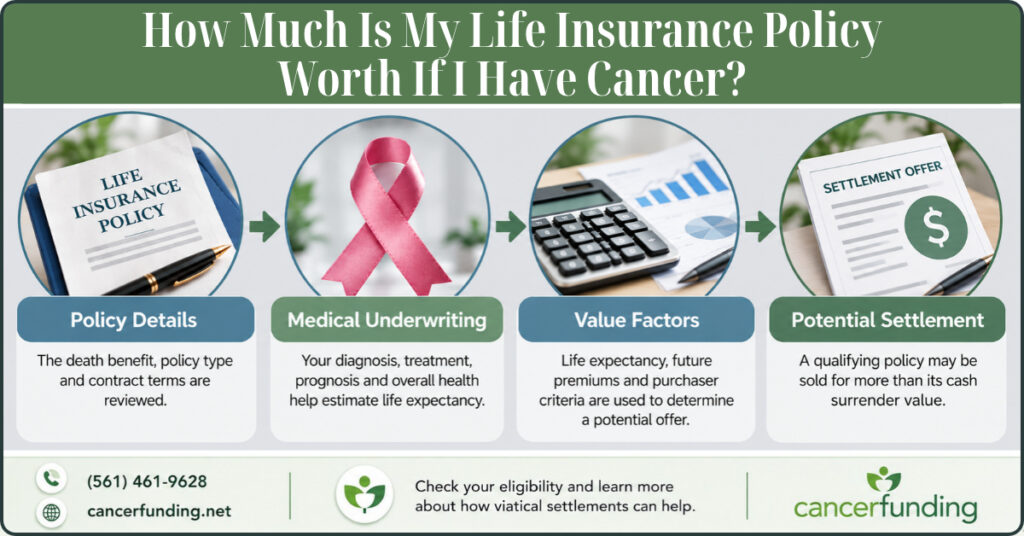
For someone diagnosed with cancer, a viatical settlement may provide an opportunity to sell a qualifying life insurance policy for a lump-sum payment while the insured person is still living. The amount available depends on several factors, including the policy’s death benefit, future premiums, and the insured person’s life expectancy.
Does a Cancer Diagnosis Affect the Value of Life Insurance?
A cancer diagnosis can influence what a third-party purchaser is willing to pay for a life insurance policy. Unlike an insurance company’s cash surrender value, which is determined by the policy’s contractual provisions, settlement value reflects the financial characteristics of acquiring and maintaining the policy.
A serious illness may affect life expectancy, which is an important consideration in determining settlement value. However, having cancer does not automatically make a policy more valuable or guarantee that it qualifies for a settlement. The specific diagnosis, stage, treatment history, prognosis, and overall health of the insured person all contribute to the evaluation.
What Is the Difference Between Face Value, Cash Value, and Settlement Value?
These three amounts represent different aspects of a life insurance policy, and understanding the distinction is important when determining what a policy may be worth.
| Type of Value | What It Means |
| Face value | The death benefit payable when the insured dies, subject to the policy’s terms. |
| Cash surrender value | The amount available from the insurance company if the owner surrenders the policy. |
| Settlement value | The amount a third-party purchaser is willing to pay to acquire the policy. |
For example, consider a permanent life insurance policy with a $500,000 death benefit and a $25,000 cash surrender value. If the owner surrenders the policy, the insurance company would pay the available $25,000, assuming no additional adjustments. However, if the insured person has cancer and the policy qualifies for a viatical settlement, a purchaser may offer more than the cash surrender value.
The actual settlement amount would depend on medical underwriting, premium obligations, and other policy characteristics. The $500,000 death benefit does not establish a fixed settlement payment, and two policies with identical face values may receive substantially different offers.
How Is the Settlement Value of a Life Insurance Policy Determined?
Life settlement purchasers evaluate the anticipated financial obligations and benefits associated with acquiring a policy. Several factors influence the amount they may be willing to pay:
- Death benefit: The amount the purchaser expects to receive when the policy matures.
- Life expectancy: The estimated period the purchaser may need to maintain the policy before receiving the death benefit.
- Future premiums: The projected cost of keeping the insurance in force.
- Policy provisions: Contract terms, premium guarantees, and other features that affect the purchaser’s obligations.
- Purchasing criteria: The requirements and financial assumptions used by the purchaser evaluating the policy.
These factors are considered together rather than independently. A policy with a substantial death benefit may receive a lower offer if maintaining it requires significant future premium payments. Conversely, a policy with manageable premiums and qualifying medical circumstances may have meaningful settlement value even when its cash surrender value is minimal.
How Does Cancer Stage and Life Expectancy Affect a Settlement Offer?
Life expectancy is one of the most important considerations in a viatical settlement evaluation because the purchaser is responsible for future premiums. The longer a policy must be maintained before the death benefit is paid, the greater the potential premium expense.
Medical underwriting helps estimate life expectancy by reviewing the insured person’s diagnosis, treatment history, response to treatment, disease progression, and overall health. These estimates are exactly that, just an estimate. They are assessments used to evaluate the financial characteristics of a potential transaction.
Cancer stage is relevant, but it does not determine settlement value by itself. Two people diagnosed with Stage III or Stage IV cancer may have very different prognoses depending on the type of cancer, available treatments, and other medical conditions. As a result, their policies may receive different valuations even when the death benefits and premium requirements are similar.
How Do Premium Payments Affect What a Life Insurance Policy Is Worth?
Future premium obligations directly influence settlement value because the purchaser must account for the cost of keeping the policy active. A policy requiring relatively low premiums may be more attractive than one with the same death benefit but substantially higher ongoing costs.
For example, consider two $500,000 policies covering insured individuals with similar life expectancy estimates. If one requires $5,000 in annual premiums and the other requires $20,000, the second policy may have a lower settlement value because maintaining it could be considerably more expensive.
Premium guarantees, existing cash value, and other contractual provisions can also affect the projected cost of maintaining coverage. This is why reviewing the actual insurance contract is an essential part of determining settlement value.
Can a Life Insurance Policy with No Cash Value Still Be Worth Money?
A life insurance policy does not necessarily need accumulated cash value to qualify for a settlement. Term life insurance generally has no cash surrender value, but certain term policies may still qualify, particularly when they include provisions allowing conversion to permanent insurance.
The potential settlement value comes from the death benefit and the policy’s characteristics rather than accumulated savings within the contract. For someone diagnosed with cancer, this distinction can be particularly important because a policy that would provide no money if surrendered or allowed to expire may still have value to a third-party purchaser.
Can the Value of a Life Insurance Policy Change After a Cancer Diagnosis?
A policy’s potential settlement value can change over time as medical circumstances, premium obligations, and purchasing criteria change. For example, successful treatment and an improved prognosis may increase estimated life expectancy, which can affect the amount a purchaser is willing to offer. Changes in health or disease progression may also influence medical underwriting assessments.
Policy-related changes can matter as well. Premium increases, approaching conversion deadlines, and changes in contractual provisions may affect the financial attractiveness of a policy. Because settlement valuations reflect the circumstances at the time of evaluation, an earlier estimate may not represent the policy’s current market value.
How Can I Find Out What My Life Insurance Policy Is Worth If I Have Cancer?
Determining the potential settlement value of your life insurance policy begins with reviewing the insurance contract and the insured person’s medical circumstances. A licensed life settlement provider can evaluate the death benefit, premium requirements, policy provisions, and available medical information to determine whether the policy may qualify for a settlement.
An initial evaluation does not obligate you to sell your policy. It can help you understand whether your life insurance has value beyond what the insurance company would pay if you surrendered it. Not every policy qualifies, but for someone living with cancer, an existing life insurance policy may represent a financial resource worth evaluating.
To learn about your eligibility for a viatical settlement to help with expenses, please reach out to Settlement Group, a licensed life settlement provider, at 754-296-9034, email inquiries@settlementgroup.io, or visit settlementgroup.io.