Many people assume that if their life insurance policy has no cash surrender value, it is worth nothing unless they pass away. However, can you sell a life insurance policy with no cash value? In certain circumstances, the answer is yes. Even a policy that cannot be surrendered for cash may have value to a third-party purchaser, particularly when the insured person has experienced a significant change in health.
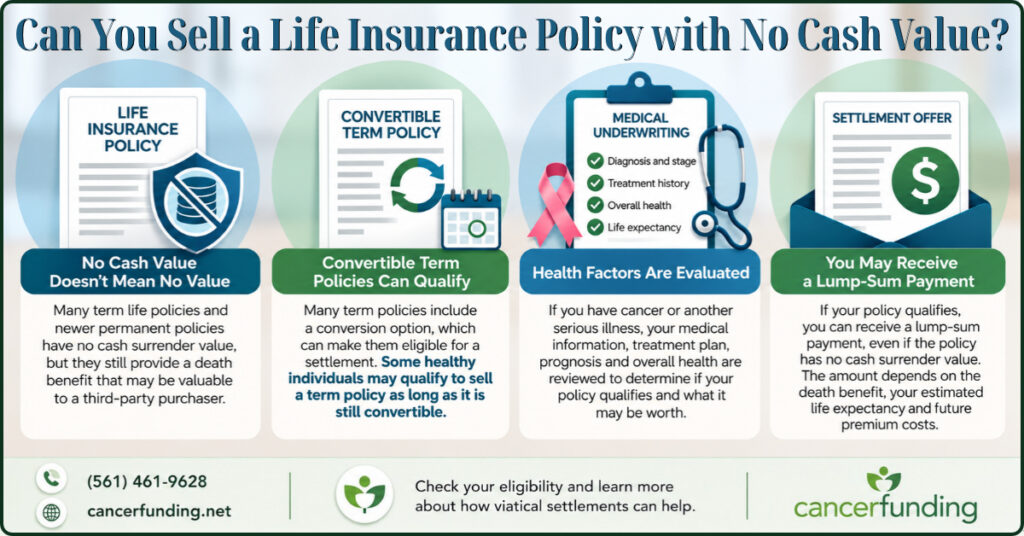
For someone diagnosed with cancer or another serious illness, this distinction can be especially important. A qualifying life insurance policy may be eligible for a viatical settlement, allowing the policy owner to receive money while the insured person is still living, even when the insurance company offers no cash surrender value.
Why Do Some Life Insurance Policies Have No Cash Value?
Life insurance policies are generally designed to provide a death benefit, but not all policies accumulate cash value. Term life insurance, for example, provides coverage for a specified period and generally does not include a savings component. If the policy expires or the owner stops paying premiums, the coverage ends without a cash payment.
Permanent policies, including whole life and universal life insurance, may accumulate cash value over time. However, a newer permanent policy may have little or no available surrender value because of policy expenses, surrender charges, or other contractual provisions.
The absence of cash value does not mean the policy lacks a death benefit. As long as the coverage remains in force, the insurer is obligated to pay the applicable death benefit when the insured dies, subject to the policy’s terms. That death benefit is what may give the policy value in the secondary market.
How Can a Life Insurance Policy Be Worth Money Without Cash Value?
The amount an insurance company pays when a policy is surrendered is different from what a third-party purchaser may be willing to pay for the coverage. Cash surrender value is determined by the insurance contract, while settlement value reflects the financial characteristics of acquiring and maintaining the policy.
When evaluating a policy, purchasers consider its death benefit, the insured person’s estimated life expectancy, future premium obligations, and other contractual provisions. A policy with no cash surrender value may still be attractive if these factors support a potential settlement.
For example, consider a life insurance policy with no cash surrender value. If the insured person has been diagnosed with a serious illness, the policy may qualify for a viatical settlement. A purchaser could offer a lump-sum payment in exchange for ownership of the policy, even though the insurance company would pay nothing if the owner surrendered it.
The amount offered would depend on the individual policy and medical circumstances. There is no guaranteed percentage of the death benefit that a policy owner can expect to receive.
Can You Sell Term Life Insurance if It Has No Cash Value?
Yes, certain term life insurance policies can be sold, although eligibility depends on the policy’s provisions and the insured person’s circumstances. Because term coverage generally has no cash surrender value, many owners are unaware that it may have value outside the insurance company.
One important consideration is whether the term policy includes a conversion provision. This feature allows eligible term coverage to be converted into permanent life insurance without additional medical underwriting, provided the conversion occurs within the policy’s contractual deadline.
A conversion provision may make a term policy more attractive to a purchaser because it can allow the coverage to continue beyond the original term. However, conversion is not available on every policy, and the cost of the resulting permanent coverage must also be considered.
If you own term life insurance and have experienced a significant health change, reviewing the conversion deadline before allowing the policy to expire may help preserve a potential settlement opportunity.
Does a Cancer Diagnosis Make a Policy with No Cash Value Eligible for Sale?
A cancer diagnosis may affect whether a life insurance policy qualifies for a viatical settlement because purchasers consider the insured person’s medical circumstances when evaluating the policy. The type and stage of cancer, treatment history, prognosis, and overall health can influence the estimated life expectancy used in the valuation.
However, a cancer diagnosis does not automatically make a policy eligible for sale. Two people with similar insurance policies may receive different evaluations because their medical conditions, treatment responses, and anticipated premium costs differ.
A person with a serious or advanced diagnosis may qualify for a viatical settlement even when the policy has no accumulated cash value. The determining factors are the policy’s characteristics and the results of medical underwriting, not whether the insurance company offers a surrender payment.
What Types of Life Insurance Policies with No Cash Value May Qualify?
Several types of coverage may be considered for a life insurance settlement, depending on the contract and the insured person’s circumstances.
- Term life insurance: Certain policies may qualify, particularly when they have conversion rights or other provisions that support continued coverage.
- Universal life insurance: A policy may have little or no cash surrender value but still provide a death benefit that a purchaser is willing to acquire.
- Whole life insurance: Although these policies are designed to accumulate cash value, newer policies or those with outstanding loans and other adjustments may have limited available surrender value.
- Group life insurance: Some employer-sponsored policies may be eligible if the coverage is portable or convertible and meets the purchaser’s requirements.
Policy ownership, assignment restrictions, premium obligations, and contractual deadlines can all affect eligibility. An evaluation of the actual insurance contract is necessary to determine whether the coverage can be sold.
How Much Can You Receive for a Policy with No Cash Value?
There is no standard settlement amount for a life insurance policy without cash value. Purchasers evaluate the death benefit alongside the insured person’s estimated life expectancy and the anticipated cost of keeping the coverage active.
For example, two policies with identical $500,000 death benefits may have different settlement values if one requires substantially higher premium payments. The purchaser must account for those future expenses when determining how much to offer.
Medical underwriting also plays an important role. A serious illness may affect the anticipated duration of the purchaser’s premium obligations, which can influence the financial value of the policy. The resulting offer, if one is made, is based on the complete evaluation rather than the absence or presence of cash value alone.
What Happens After You Sell a Life Insurance Policy?
When a life insurance policy is sold through a traditional viatical settlement, ownership and beneficiary rights are transferred to the purchaser. The purchaser assumes responsibility for future premium payments and receives the death benefit when the insured dies.
In exchange, the seller receives the agreed settlement payment. Those funds can be used for medical treatment, household expenses, debt, caregiving, or other financial needs without restrictions imposed by the settlement purchaser.
Selling the policy also means giving up the death benefit that would otherwise have been payable to the original beneficiaries, unless the transaction includes a retained death benefit arrangement. Understanding this tradeoff is important when evaluating whether a settlement meets your financial needs.
How Can You Find Out if Your Policy Has Settlement Value?
If your life insurance policy has no cash surrender value, an evaluation can help determine whether it may still qualify for a settlement. A licensed life settlement provider can review the policy’s death benefit, premium requirements, conversion provisions, and other contractual features alongside the insured person’s medical circumstances.
You do not need to know the potential settlement value before requesting an evaluation. The purpose of the review is to determine whether the policy meets purchasing criteria and whether a settlement offer may be available.
A policy that cannot be surrendered for cash is not necessarily worthless. For someone facing cancer or another serious illness, learning about the potential value of existing life insurance coverage may reveal a much needed source of funds.
To learn if you may qualify for a viatical settlement to help with expenses, please reach out to Settlement Group, a licensed life settlement provider, at 754-296-9034, email inquiries@settlementgroup.io, or visit settlementgroup.io.