When you need access to money from your life insurance policy, understanding your options can make a significant financial difference. Understanding cash value vs. viatical settlement value is an important consideration for policy owners, particularly those facing cancer or another serious illness. Both options may provide funds while you are living, but they work differently, have different eligibility requirements, and can produce substantially different financial outcomes.
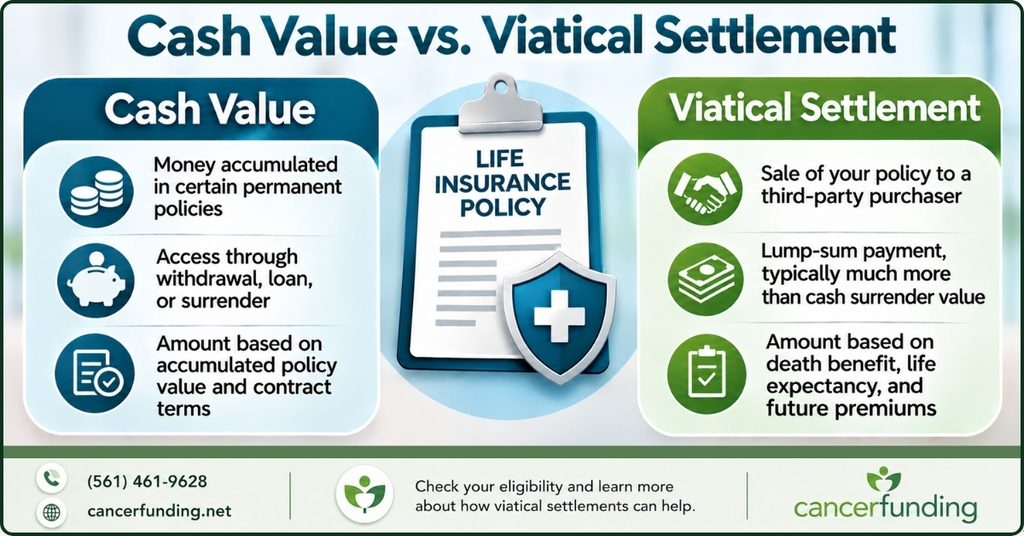
Cash value represents money accumulated within certain permanent life insurance policies. A viatical settlement involves selling an existing policy to a third-party purchaser for a lump-sum payment. Understanding the differences can help you determine which option may be available and what each would mean for your coverage.
What Is the Cash Value of a Life Insurance Policy?
Cash value is a feature of certain permanent life insurance policies, including whole life and universal life insurance. A portion of the premiums paid into these policies may contribute to an accumulated value that grows over time according to the policy’s terms.
Policy owners may access this value through withdrawals, policy loans, or surrendering the coverage. The amount available depends on the accumulated value, outstanding loans, surrender charges, and other contractual provisions.
Term life insurance generally does not accumulate cash value. Someone who owns a term policy may therefore have no money available through surrender, even though the policy provides a substantial death benefit.
What Is a Viatical Settlement?
A viatical settlement is the sale of a life insurance policy by an eligible policy owner to a third-party purchaser. The seller receives a lump-sum payment, while the purchaser assumes responsibility for future premiums and ultimately receives the death benefit.
Viatical settlements are for individuals diagnosed with terminal or serious illnesses, including certain cancers. Buyers evaluate the insured person’s medical circumstances alongside the policy’s death benefit, premium requirements, and contractual provisions.
Unlike cash value, which is determined by the insurance contract, settlement value reflects what a purchaser is willing to pay. A qualifying viatical settlement provides more than the policy’s cash surrender value but less than its death benefit.
How Does Cash Value Compare to a Viatical Settlement?
Although both options may provide immediate access to money from an existing life insurance policy, their financial characteristics are different.
| Feature | Cash Value | Viatical Settlement |
| Source of funds | Value accumulated within the policy | Payment from a third-party purchaser |
| Eligible policies | Permanent policies with available cash value | Qualifying permanent and certain term policies |
| Health requirements | Generally no medical qualification required | Medical circumstances affect eligibility and value |
| Amount available | Based on accumulated value and policy provisions | Based on death benefit, life expectancy, premiums, and other factors |
| Effect on coverage | When a policy is surrendered, coverage stops | Ownership and beneficiary rights generally transfer |
| Future premiums | No premiums if a policy is cancelled | Become the purchaser’s responsibility |
The key distinction is that cash value is established by the insurance policy, while settlement value is determined through an evaluation in the secondary market. For someone with a serious illness, a settlement can provide substantially more money than surrendering the policy.
Can a Viatical Settlement Pay More Than Cash Surrender Value?
A viatical settlement provides a payment greater than the policy’s cash surrender value.
Consider a hypothetical permanent life insurance policy with a $500,000 death benefit and a $30,000 cash surrender value. If the owner surrenders the policy, the insurance company would pay the available $30,000, assuming no additional adjustments.
If the policy qualifies for a viatical settlement, a purchaser may offer substantially more because the transaction is based on the death benefit and other financial characteristics rather than accumulated cash value.
There is no fixed percentage of the death benefit that every seller receives. Medical underwriting, future premium obligations, and policy provisions influence the amount offered. Many viatical settlement offers are up to 50-80% of the policy’s death benefit.
Can You Get a Viatical Settlement if Your Policy Has No Cash Value?
A policy does not need accumulated cash value to qualify for a settlement. Even term life insurance, which generally has no surrender value, may still have value to a third-party purchaser.
Certain term policies include conversion provisions allowing the coverage to be converted into permanent insurance without new medical underwriting. In most cases, a policy must still be convertible in order to qualify for a settlement. However, some non-convertible term policies may still qualify, so it is always best to have your policy appraised for potential value.
Although serious medical conditions influence viatical settlement eligibility, some healthy individuals may qualify to sell convertible term coverage through a traditional life settlement. The absence of cash value alone does not determine whether a policy can be sold.
What Happens to Your Coverage When You Access Cash Value or Sell Your Policy?
Only certain types of policies allow for cash to be withdrawn. A withdrawal may reduce the policy’s cash value and death benefit, while a policy loan generally allows coverage to remain in force if sufficient value is maintained.
Outstanding loans and interest can reduce the amount payable to beneficiaries. Surrendering a policy terminates coverage entirely, eliminating the death benefit.
A traditional viatical settlement transfers ownership and beneficiary rights to the purchaser. The seller receives the agreed payment, and the purchaser generally assumes future premiums. Some transactions may allow the seller to retain a portion of the death benefit, depending on the arrangement.
Are Cash Value Withdrawals and Viatical Settlements Taxed Differently?
Tax treatment depends on how the policy owner accesses the money. Withdrawals may be taxable when they exceed the owner’s investment in the contract, while policy loans are generally not immediately taxable if the policy remains in force and applicable requirements are satisfied. Surrendering coverage can also create taxable income when proceeds exceed the policy’s tax basis.
Viatical settlement proceeds may qualify for exclusion from federal income tax under Internal Revenue Code Section 101(g) when applicable requirements are met.
A cancer diagnosis alone does not guarantee tax-free treatment. Funds received through either option may also affect eligibility for needs-based benefits, including Medicaid and Supplemental Security Income (SSI).
Which Option Makes More Sense for Your Financial Needs?
The appropriate choice depends on your financial circumstances, the type of insurance you own, and whether maintaining coverage for beneficiaries remains a priority.
Accessing cash value through a withdrawal or loan may be suitable when you need a smaller amount and want to preserve coverage, but withdrawals are not available for all types of policies. Surrendering provides the available cash surrender value, but permanently terminates the policy.
A viatical settlement may be worth considering when you no longer need the full death benefit, cannot comfortably maintain premiums, or need access to more money than surrendering the policy would provide.
Before surrendering coverage or allowing it to lapse, determining whether it qualifies for a settlement can help you understand its potential value.
How Can You Compare Your Policy’s Cash Value and Settlement Value?
Your insurance company’s current policy statement can help establish the available cash surrender value, outstanding loans, and premium requirements. However, it does not necessarily reflect what a third-party purchaser might pay.
A licensed life settlement provider can review the policy’s death benefit, contractual provisions, premium obligations, and the insured person’s medical circumstances to determine whether a settlement may be available.
An initial evaluation does not obligate you to sell your policy. It provides an opportunity to understand whether your coverage has value beyond the amount available through surrender.
To learn if you may qualify for a viatical settlement to help with expenses, please reach out to Settlement Group, a licensed life settlement provider, at 754-296-9034, email inquiries@settlementgroup.io, or visit settlementgroup.io.