Life insurance is designed to provide financial protection for your beneficiaries after your death, but that does not mean the policy has no value to you today. Can you cash out life insurance while you’re still alive? Yes, depending on the type of policy you own, its provisions, and your circumstances, you may be able to access money from your life insurance policy without waiting for a death benefit to be paid.
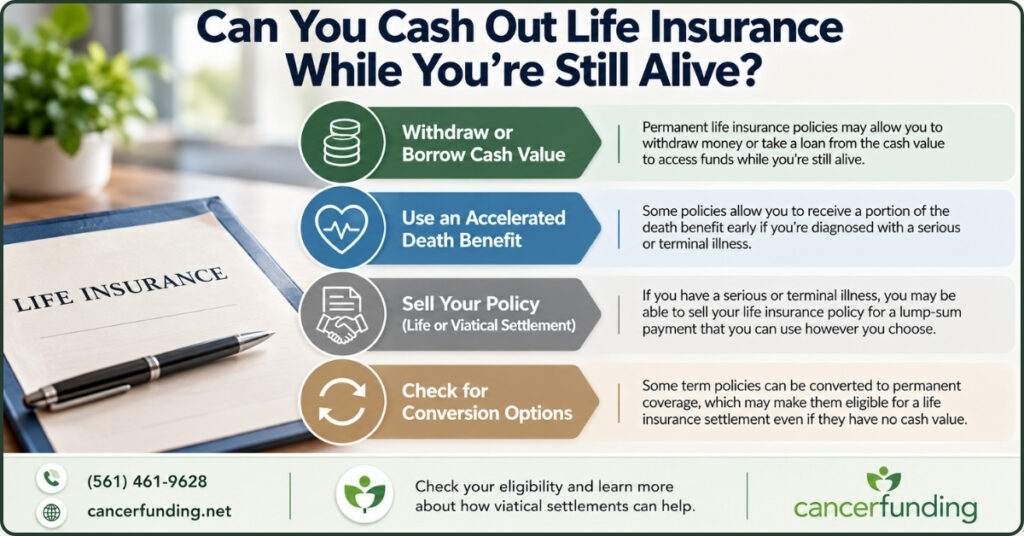
There are several ways to access the value of a life insurance policy, including cash value withdrawals, policy loans, accelerated death benefits, and life insurance settlements. For people living with cancer or another serious illness, understanding these options can be particularly important when medical expenses and everyday financial obligations become difficult to manage.
What Does It Mean to Cash Out a Life Insurance Policy?
Cashing out life insurance means accessing some or all of the financial value associated with a policy while the insured person is still living. However, the amount available depends on how that value is accessed.
Some permanent life insurance policies accumulate cash value that the owner can withdraw, borrow against, or receive by surrendering the policy. Other policies may provide access to an accelerated death benefit when certain medical requirements are met.
A life insurance settlement offers another option. Instead of receiving money directly from the insurance company, an eligible policy owner sells the policy to a third-party purchaser in exchange for a lump-sum payment.
These options have different outcomes, particularly regarding whether the policy remains in force and how much money beneficiaries may eventually receive.
Can You Withdraw Cash from a Life Insurance Policy?
Permanent life insurance policies, including whole life and certain universal life policies, can accumulate cash value over time. Depending on the contract, the policy owner may be able to withdraw some of that value or borrow against it.
A withdrawal generally reduces the policy’s available cash value and may also reduce the death benefit. Policy loans allow the owner to borrow against accumulated cash value, but interest can accrue, and unpaid balances can reduce the amount ultimately paid to beneficiaries.
Withdrawals and loans can also create tax consequences in certain circumstances, particularly if a policy lapses or is classified as a modified endowment contract.
Term life insurance generally does not accumulate cash value, which means these options are usually unavailable to term policy owners.
Can You Surrender Your Life Insurance Policy for Cash?
Surrendering a permanent life insurance policy means voluntarily terminating the contract in exchange for its available cash surrender value.
The cash surrender value is the amount the insurance company will pay when the policy is surrendered, after accounting for applicable charges and outstanding loans. Once the policy is surrendered, the life insurance coverage ends, and beneficiaries will no longer receive a death benefit.
For someone who no longer needs the policy or cannot afford the premiums, surrendering may seem like a reasonable option. However, the cash surrender value is not necessarily the same as the policy’s potential value in a life insurance settlement.
Before surrendering a policy, particularly after a serious medical diagnosis, it is definitely worth checking if your policy qualifies for a settlement that could provide a larger payment. Many times, life settlements provide much more than the cash surrender value.
Can You Access Your Life Insurance Death Benefit Before You Die?
Some life insurance policies include an accelerated death benefit provision, sometimes called a living benefit. This allows an eligible policy owner to receive a portion of the death benefit while the insured person is still alive.
Insurance companies establish specific requirements for accessing these benefits. Depending on the policy, eligibility may be tied to a terminal illness, certain chronic conditions, or another qualifying diagnosis.
Not everyone with a serious illness qualifies for an accelerated death benefit. The amount available may also be limited, even when the policy has a substantial death benefit.
Receiving an accelerated death benefit generally reduces the amount remaining for beneficiaries. However, it may allow the policy owner to access needed funds without transferring ownership of the policy.
Can You Sell Your Life Insurance Policy for Cash?
Yes. An eligible life insurance policy can be sold to a third-party purchaser through a life settlement or viatical settlement.
Viatical settlements are the sale of a policy when the insured has a serious or terminal illness. The policy owner receives a lump-sum payment in exchange for transferring ownership of the policy to the purchaser.
After the sale, the purchaser assumes responsibility for future premiums and receives the death benefit when the insured dies. In some transactions, a retained death benefit arrangement may allow the seller to preserve a portion of the benefit for beneficiaries.
The settlement payment is greater than the policy’s cash surrender value and less than its death benefit. Unlike a policy loan, the money does not have to be repaid.
Settlement proceeds can be used for any purpose, including medical treatment, housing, caregiving, household bills, debt, or other financial needs.
Can You Cash Out Term Life Insurance While You’re Still Alive?
Although term life insurance generally has no cash surrender value, some term policies may qualify for a life insurance settlement.
One important factor is whether the policy includes a conversion provision. This allows the owner to convert eligible term insurance into permanent coverage without new medical underwriting, subject to the policy’s requirements and conversion deadline.
For someone diagnosed with cancer or another serious illness, a convertible term policy may have value to a settlement purchaser even though the insurance company offers no cash surrender value.
Not every term policy qualifies, but having no accumulated cash value does not automatically mean the policy cannot be sold.
How Much Money Can You Get by Cashing Out Life Insurance?
The amount a policy is worth can vary widely based on policy provisions and the health status of the insured.
For withdrawals, loans, and surrender transactions, the available cash value and policy terms determine how much money can be accessed. Accelerated death benefits are governed by the insurance company’s eligibility requirements and benefit limits.
For a life insurance settlement, the amount offered depends on factors including the policy’s death benefit, future premium obligations, the insured person’s age and health, life expectancy, and market conditions.
A policy with little or no cash surrender value may still qualify for a substantial settlement payment. This is why evaluating the policy’s potential settlement value can be especially important before allowing it to lapse or surrendering it.
Will Cashing Out Life Insurance Affect Your Taxes or Government Benefits?
It can. Tax treatment depends on how the money is received, the policy’s cost basis, and the insured person’s circumstances.
For example, certain accelerated death benefits and qualifying viatical settlement proceeds may receive favorable federal income tax treatment under Internal Revenue Code Section 101(g). However, not every life insurance transaction qualifies for tax-free treatment.
Receiving a large payment may also affect eligibility for needs-based programs such as Medicaid or Supplemental Security Income (SSI). Medicare and Social Security Disability Insurance (SSDI) generally are not subject to the same asset limits.
Understanding these distinctions before completing a transaction can help prevent unexpected financial consequences.
How Do You Find Out if Your Life Insurance Policy Can Be Cashed Out?
The first step is identifying the type of policy you own, its death benefit, premium requirements, available cash value, and any accelerated death benefit or conversion provisions.
If you have cancer or another serious illness, you can also request an evaluation to determine whether your policy may qualify for a viatical settlement. This can help establish whether selling the policy would provide more money than surrendering it or accessing its available cash value.
Requesting an evaluation does not obligate you to sell. It simply provides information about an additional financial option that may be available while you are still living.
To learn if you may qualify for a viatical settlement to help with expenses, please reach out to Settlement Group, a licensed life settlement provider, at 754-296-9034, email inquiries@settlementgroup.io, or visit settlementgroup.io