If you rely on government health coverage, you may wonder, can you get a viatical settlement if you have Medicare or Medicaid? Having Medicare or Medicaid does not automatically prevent you from selling a qualifying life insurance policy through a viatical settlement. However, the financial impact can be different depending on which program provides your coverage. Medicare eligibility is generally not based on income or assets, while certain Medicaid programs have financial eligibility requirements that may be affected by receiving a lump-sum settlement.
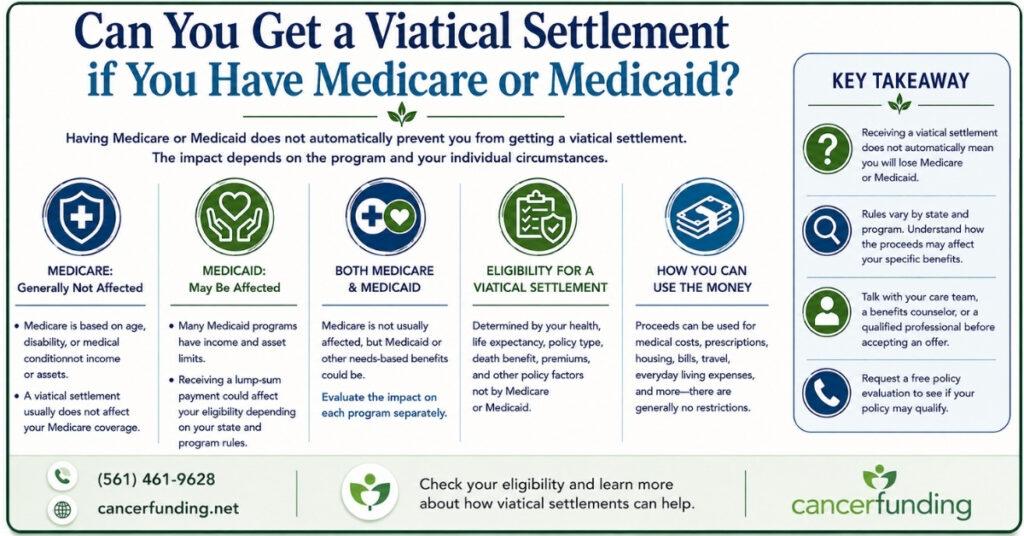
Can You Get a Viatical Settlement While on Medicare?
Yes. Having Medicare does not prevent you from qualifying for a viatical settlement.
Medicare eligibility is generally based on age, disability, or certain medical conditions rather than financial need. Because Medicare itself does not have an asset limit, receiving money from a viatical settlement does not ordinarily cause someone to lose Medicare coverage simply because their assets have increased.
Eligibility for the viatical settlement itself is determined separately. Factors such as the insured’s health and life expectancy, the type of life insurance policy, death benefit, and future premiums can all affect whether a policy qualifies and what it may be worth.
Does a Viatical Settlement Affect Medicare Benefits?
A viatical settlement generally does not affect eligibility for Medicare Part A or Part B because these programs are not means-tested.
However, someone receiving Medicare may also participate in other programs that are based on income or financial resources. Those additional benefits require separate consideration.
For example, a Medicare beneficiary may also receive Medicaid or assistance with Medicare premiums and other healthcare expenses through an income-based program. Receiving a large lump-sum payment could potentially affect eligibility for those benefits even though the person’s underlying Medicare eligibility remains unchanged.
This is why it is important to consider all of the benefits you receive, rather than Medicare alone, before completing a settlement.
Can You Get a Viatical Settlement While on Medicaid?
Having Medicaid does not automatically prevent you from obtaining a viatical settlement either. The important difference is that many Medicaid eligibility categories consider a person’s income, assets, or both.
A viatical settlement provides a lump-sum cash payment in exchange for a qualifying life insurance policy. Depending on the Medicaid program and the recipient’s circumstances, receiving and retaining those funds could affect financial eligibility.
Medicaid rules also vary by state and by the particular eligibility category under which someone receives benefits. For that reason, there is no single answer that applies to every Medicaid recipient.
If you receive Medicaid, it is particularly important to understand how settlement proceeds would be treated under the rules that apply to your coverage before accepting an offer.
Will a Viatical Settlement Make Me Lose Medicaid?
Not necessarily. Receiving a viatical settlement does not automatically mean that someone will permanently lose Medicaid. Whether the payment affects eligibility depends on the applicable Medicaid rules, the amount received, how the funds are treated, and the individual’s financial circumstances.
Income and asset rules can also work differently. A payment may be considered one way during the month it is received and another way if money remains in an account afterward.
Because these rules can be complicated and vary by program and state, someone receiving Medicaid should determine how a proposed settlement would affect their specific benefits.
What If I Have Both Medicare and Medicaid?
Some people qualify for both programs. This is often referred to as being dual eligible.
If you have both Medicare and Medicaid, the fact that Medicare itself is not generally asset-tested does not eliminate concerns about Medicaid eligibility. You still need to consider the financial requirements associated with your Medicaid coverage and any other needs-based benefits you receive.
In other words, someone can remain eligible for Medicare while experiencing a change in eligibility for Medicaid or another financial assistance program.
If you receive both, make sure you evaluate the potential effect on each program separately.
Can Life Insurance Affect Medicaid Eligibility Before You Sell It?
Life insurance itself can sometimes be relevant to Medicaid eligibility, even before considering a viatical settlement.
How a life insurance policy is treated can depend on the type of coverage and the Medicaid program involved. Permanent policies such as whole life insurance may accumulate cash value, while term life insurance generally does not.
A viatical settlement changes the situation because the policy is exchanged for cash. Even if the life insurance policy itself was not considered a countable resource, the proceeds received from selling it may be treated differently.
This is another reason not to assume that the Medicaid treatment of the policy will be identical to the treatment of the settlement proceeds.
Does Medicare or Medicaid Determine Whether My Policy Qualifies?
No. Medicare and Medicaid coverage do not determine whether a life insurance policy qualifies for a viatical settlement.
Viatical settlement eligibility is based on the insured’s medical circumstances and the life insurance policy.
Policies that may qualify include:
- Whole life insurance
- Universal life insurance
- Certain term life insurance policies
- Other qualifying permanent life insurance policies
A policy may have settlement value even if it has little or no cash surrender value.
The insured’s diagnosis, overall health, estimated life expectancy, policy death benefit, premium requirements, and other policy characteristics may all be considered when determining whether a settlement is possible.
Can You Use Viatical Settlement Money for Medical Expenses?
Yes. Viatical settlement proceeds can generally be used for whatever expenses the policy owner chooses.
Someone receiving Medicare or Medicaid may use the money to help pay for expenses such as:
- Medical treatment
- Prescription medications
- Health insurance costs
- In-home care
- Travel and lodging for treatment
- Mortgage or rent
- Utilities and groceries
- Transportation
- Debt
- Everyday living expenses
There is generally no requirement that viatical settlement proceeds be used only for healthcare.
However, how you use or retain the money may be important if you receive benefits with financial eligibility requirements. Spending the proceeds on an allowable expense does not necessarily mean the transaction will have no effect on benefits, so the applicable program rules should be reviewed beforehand.
What Other Benefits Could a Viatical Settlement Affect?
Medicaid is not the only needs-based program to consider.
If you receive other assistance based on income or assets, a lump-sum payment could potentially affect those benefits as well. Examples may include Supplemental Security Income (SSI), housing assistance, food assistance, or programs that help with Medicare costs.
The rules for each program are different.
Before accepting a viatical settlement, make a list of the government benefits and financial assistance programs you currently receive. That makes it easier to determine which programs, if any, could be affected by the proceeds.
Should You Have Your Life Insurance Policy Evaluated If You Receive Medicare or Medicaid?
Having Medicare or Medicaid does not mean that you should automatically rule out a viatical settlement.
If you have a qualifying illness and an existing life insurance policy, an evaluation can determine whether the policy may qualify and how much you may be able to receive. Requesting an evaluation does not obligate you to accept an offer or sell your policy.
If you receive Medicaid or another needs-based benefit, however, determining what your policy is worth is only part of the decision. Before accepting a settlement, you should also understand how the proceeds could affect the specific benefits you rely on.
That allows you to evaluate the potential cash payment alongside any consequences for your existing assistance and make an informed decision before the policy is sold.
To learn if you may qualify for a viatical settlement to help with expenses, please reach out to Settlement Group, a licensed life settlement provider at 754-296-9034, email inquiries@settlementgroup.io, or visit settlementgroup.io.