A cancer diagnosis can affect nearly every aspect of your financial life, including your life insurance coverage. If you are wondering, can you sell a term life insurance policy after a cancer diagnosis?, the answer depends on the type of term policy you own and your specific circumstances. While many term life insurance policies have little or no cash value, some can qualify for a viatical settlement or be converted to permanent coverage before being sold. Understanding your options can help you determine whether your policy may provide funds to help cover treatment costs, household expenses, or other financial needs.
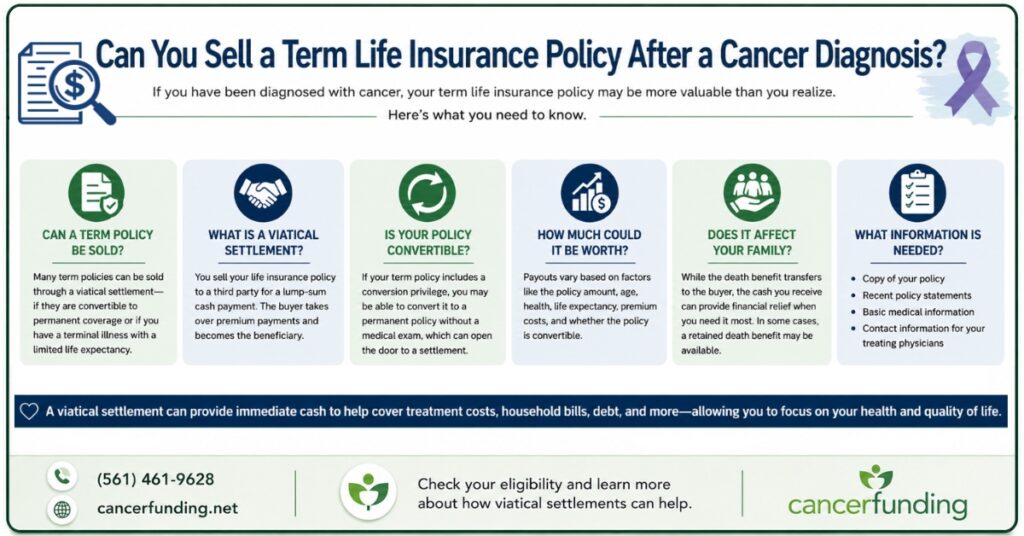
Can a Term Life Insurance Policy Be Sold?
Unlike whole life or universal life insurance, term life insurance is designed to provide coverage for a specific number of years without building cash value. Because of this, many people assume a term policy cannot be sold.
However, that is not always the case.
A term life insurance policy may qualify for a viatical settlement if:
- The policy includes a conversion privilege that allows it to be converted to permanent life insurance.
- The policyholder has been diagnosed with a qualifying serious or terminal illness.
- The converted policy meets the requirements of potential viatical settlement providers.
If the policy is non-convertible, selling it is generally much more difficult. In most cases, a non-convertible term policy can only qualify if the insured has a terminal illness and a limited life expectancy.
What Is a Viatical Settlement?
A viatical settlement allows someone with a serious illness to sell their life insurance policy for a lump-sum cash payment that is greater than the policy’s surrender value but less than its death benefit.
After the sale:
- The buyer becomes responsible for future premium payments.
- The buyer becomes the beneficiary of the policy.
- The original owner receives immediate cash that can be used for any purpose.
Many people use viatical settlement proceeds to pay for:
- Cancer treatment expenses
- Prescription medications
- Travel for specialized care
- Household bills
- Mortgage payments
- Paying off debt
- Improving overall quality of life
Unlike many forms of financial assistance, there are generally no restrictions on how the proceeds can be spent.
Is Your Term Policy Convertible?
One of the most important factors is whether your policy includes a conversion privilege.
A convertible term policy allows you to exchange your term coverage for a permanent life insurance policy without undergoing a new medical exam. Because your current health is typically not reconsidered during the conversion period, this option can be especially valuable after a cancer diagnosis.
Many people are unaware that they even have this feature. Your insurance policy or your insurance company can usually confirm whether your policy is convertible and whether the conversion period is still available.
Not every term policy includes this benefit, so reviewing the policy details is an important first step.
What If Your Policy Is Non-Convertible?
If your policy cannot be converted, your options become more limited.
Most non-convertible term policies cannot be sold because they cannot be converted into permanent life insurance. Although many continue as annual renewable term (ART) policies after the initial level-premium period ends, the premiums typically increase significantly each year. Those rapidly rising costs often make the policy impractical for a buyer to maintain, limiting its value in the viatical settlement market.
However, there can be exceptions.
Some viatical settlement providers may consider purchasing a non-convertible term policy when the insured has a terminal illness and a very limited life expectancy. Each case is evaluated individually, and eligibility depends on several factors, including the policy itself and the medical information available.
How Much Could a Policy Be Worth?
There is no standard payout for a viatical settlement.
Several factors influence the value of a policy, including:
- The face amount of the policy
- The insured’s age
- Overall health and medical diagnosis
- Life expectancy
- Premium costs
- Whether the policy is convertible
- The type of permanent policy created after conversion
In general, policies with larger death benefits and shorter projected life expectancies tend to receive higher settlement offers. Every case is unique, so an individual evaluation is necessary to determine whether a policy has value in the viatical settlement market.
Does Selling Your Policy Affect Your Family?
One of the biggest concerns people have is how selling a life insurance policy could affect their loved ones.
While a viatical settlement typically transfers the policy’s death benefit to the buyer, many families find that receiving financial assistance during cancer treatment provides far greater value than maintaining the full death benefit for the future. The proceeds can help pay for medical expenses, household bills, travel for treatment, debt, or other costs at a time when financial stress is often at its highest.
In some cases, a retained death benefit may also be available. This arrangement allows you to receive a portion of your policy’s value today while preserving a portion of the death benefit for your beneficiaries.
Every family’s situation is different. For some, preserving the entire death benefit remains the right choice. For others, accessing the value of the policy during treatment can provide meaningful financial relief and greater peace of mind while focusing on their health.
What Information Is Needed for a Viatical Settlement?
If you are exploring whether your policy qualifies, you will usually need:
- A copy of your life insurance policy
- Recent policy statements
- Basic medical information
- Contact information for your treating physicians
Additional documentation may be requested during the evaluation process, but an initial review can often determine whether the policy appears eligible.
Do You Qualify to Sell Your Term Life Insurance Policy?
If you have been diagnosed with cancer, your term life insurance policy may be more valuable than you realize. While not every term policy qualifies, many convertible term policies can become eligible for a viatical settlement after being converted to permanent coverage. Even some non-convertible policies may qualify in limited circumstances involving terminal illness.
The only way to know whether your policy qualifies is to have it professionally reviewed. An experienced viatical settlement company can evaluate your policy, explain your options, and let you know whether you may be eligible to receive a lump-sum cash payment. There is no obligation to have your policy reviewed, making it an easy first step toward understanding your options during cancer treatment.
To learn if you’re likely to qualify, please reach out to Settlement Group, a licensed life settlement provider at 754-296-9034, email inquiries@settlementgroup.io, or visit settlementgroup.io.