“I need money to pay for cancer treatment, but I have no idea where to start.” A cancer diagnosis is stressful even before considering finances. There may be several sources of financial help available though. Depending on your situation, you may be able to get assistance with treatment costs, medications, travel, household bills, and other expenses that become difficult to manage during cancer treatment.
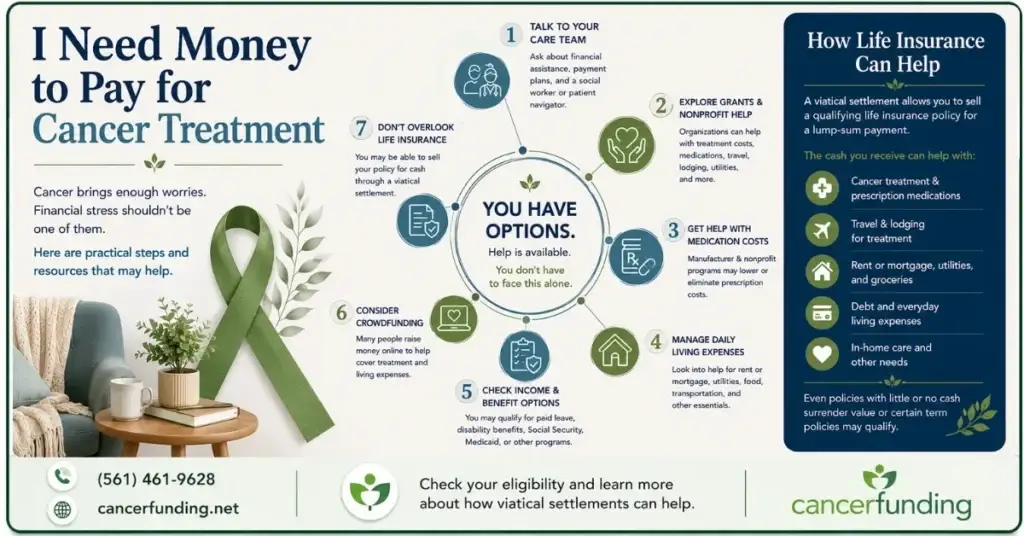
Options can include financial assistance from your hospital, cancer grants and nonprofit programs, prescription assistance, government benefits, and even the value of a life insurance policy you already own. The right resources will depend on what you need help paying for and your individual circumstances.
What Can I Do If I Can’t Afford Cancer Treatment?
If you are struggling to afford treatment, start by telling your cancer care team. Hospitals and cancer centers often have social workers, patient navigators, or financial counselors who help patients find resources.
Ask specifically about:
- Hospital financial assistance or charity care
- Payment plans
- Programs that help with copayments and deductibles
- Prescription assistance
- Transportation and lodging assistance
- Local and national cancer organizations
- Programs available specifically for your type of cancer
Do not assume you will not qualify for assistance because you have health insurance or because your household has income. Different programs use different eligibility requirements.
If you have already received large medical bills, ask for itemized statements and review them for errors. You can also ask whether your provider offers financial assistance based on income or financial hardship.
Are There Grants to Help Pay for Cancer Treatment?
Yes. Some nonprofit organizations and foundations offer grants or other financial assistance to people with cancer.
Depending on the program, assistance may help with medical costs as well as expenses such as transportation, lodging, utilities, food, or other necessities.
Some programs are available only to people with specific types of cancer. Others may have income requirements or limit assistance to certain expenses.
Funding can also change throughout the year. A program that does not have funding available today may reopen later, while another organization may have resources available immediately.
A hospital social worker or patient navigator may be able to help identify programs that match your diagnosis and financial circumstances.
How Can I Get Cancer Treatment If I Don’t Have Insurance?
If you do not have health insurance, ask your treatment center about its financial assistance and charity care policies as soon as possible.
You may also want to find out whether you qualify for Medicaid or another health coverage program. Eligibility depends on factors such as income, household circumstances, disability status, and where you live.
Some cancer centers also have programs for uninsured or underinsured patients, and nonprofit organizations may provide assistance with specific treatment-related expenses.
If you are uninsured, do not assume that you have to find the full cost of treatment on your own before asking for care. Speak with the treatment facility about your financial situation and ask what programs or payment options may be available.
What If I Can’t Afford My Cancer Medications?
Tell your oncologist or treatment team if you are having difficulty paying for a prescribed medication.
Pharmaceutical manufacturers may offer patient assistance programs for certain medications. Nonprofit organizations may also provide grants or copayment assistance for eligible patients.
Your oncology practice may have someone on staff who works specifically with medication assistance programs and can help with applications.
If the cost of a medication is preventing you from filling a prescription, contact your healthcare provider rather than simply going without it. Your care team may be able to identify financial assistance or discuss other appropriate options.
How Can I Pay My Bills If I Can’t Work Because of Cancer?
Cancer can create a financial problem even when treatment itself is largely covered by insurance. If you have to stop working, reduce your hours, or take frequent unpaid time off for appointments, it may become difficult to pay your mortgage or rent, utilities, groceries, transportation, and other regular expenses.
Depending on your circumstances, you may be able to explore:
- Employer-provided paid leave
- Short-term or long-term disability insurance
- Social Security disability benefits
- Utility assistance programs
- Housing assistance
- Nonprofit grants
- Local community resources
Contacting creditors and service providers early may also help. Some mortgage companies, utility providers, lenders, and credit card companies have hardship programs or temporary payment arrangements.
Can I Get Help Paying Rent or a Mortgage While I Have Cancer?
Some cancer assistance organizations and community programs help with non-medical expenses, including housing and utilities. Availability varies significantly by location and available funding.
If keeping up with housing expenses is becoming difficult, a hospital social worker may be able to identify local organizations that provide emergency assistance.
You can also contact your mortgage servicer or landlord before you fall significantly behind. Depending on the situation, there may be temporary arrangements available.
Financial help with housing can be especially important during cancer treatment because keeping a stable home can relieve one source of stress while you are dealing with medical care.
Can Crowdfunding Help Pay for Cancer Treatment?
Some patients and families use online crowdfunding to raise money for treatment and related expenses.
Crowdfunding may help with medical bills, transportation, lodging, household expenses, or income lost during treatment. How much someone is able to raise depends heavily on their personal network and how widely the fundraiser is shared.
If you choose to use crowdfunding, be clear about why you are raising money and what types of expenses the funds will help cover.
It is also worth considering how money received through crowdfunding could affect any income-based assistance or benefits you receive. If you are unsure, ask the applicable program or a qualified professional before relying on crowdfunding funds.
Can I Use Life Insurance to Pay for Cancer Treatment?
If you already own life insurance, your policy may be a financial resource you have not considered.
People with qualifying serious or terminal illnesses may be able to sell an eligible life insurance policy through a viatical settlement. In exchange for the policy, the owner receives a lump-sum cash payment.
Viatical settlement proceeds can help with cancer treatment, prescription costs, travel, housing, everyday bills, or virtually any other expense. There are generally no requirements that the money be spent only on medical care.
Whole life, universal life, and certain term life insurance policies may qualify. A policy can potentially have settlement value even if it has little or no cash surrender value.
If you have term coverage, see Can you sell a term life insurance policy after a cancer diagnosis? for a more detailed explanation of when a term policy may qualify.
Is Selling Life Insurance the Same as Taking a Loan Against It?
No. A viatical settlement is different from borrowing against a life insurance policy.
Some permanent life insurance policies accumulate cash value that the policy owner may be able to access through withdrawals or policy loans. The amount available depends on the policy and its accumulated value.
A viatical settlement involves selling the policy rather than borrowing from it. Eligibility and the amount available are based on factors that include the insured’s health, estimated life expectancy, policy death benefit, and future premium costs.
For someone with a qualifying illness, a viatical settlement may provide access to value even when the policy has little or no cash surrender value.
Where Can I Find Emergency Financial Help for Cancer Patients?
If you need financial assistance immediately, prioritize the expenses that are most urgent and contact several potential sources of help rather than relying on a single program.
Start with your hospital or cancer center and ask to speak with a social worker, financial counselor, or patient navigator. Explain exactly what you need help with, whether that is treatment, medication, transportation, housing, utilities, or another expense.
You can also contact nonprofit cancer organizations, community assistance programs, medication assistance programs, and government benefit programs for which you may qualify.
If you own life insurance, you can have your policy evaluated to determine whether a viatical settlement may provide another source of funds. Requesting an evaluation does not obligate you to sell the policy.
When you need money for cancer treatment, the best solution may involve several resources rather than one source paying for everything. Identifying the most urgent financial needs first and exploring assistance specifically designed for those expenses can help you find options more quickly.
To learn if you may qualify for a viatical settlement to help with expenses, please reach out to Settlement Group, a licensed life settlement provider at 754-296-9034, email inquiries@settlementgroup.io, or visit settlementgroup.io.