A Stage IV cancer diagnosis can create significant financial challenges at the same time that patients and their families are trying to focus on treatment and quality of life. If you own life insurance, you may be wondering, can you sell a life insurance policy with Stage IV cancer?
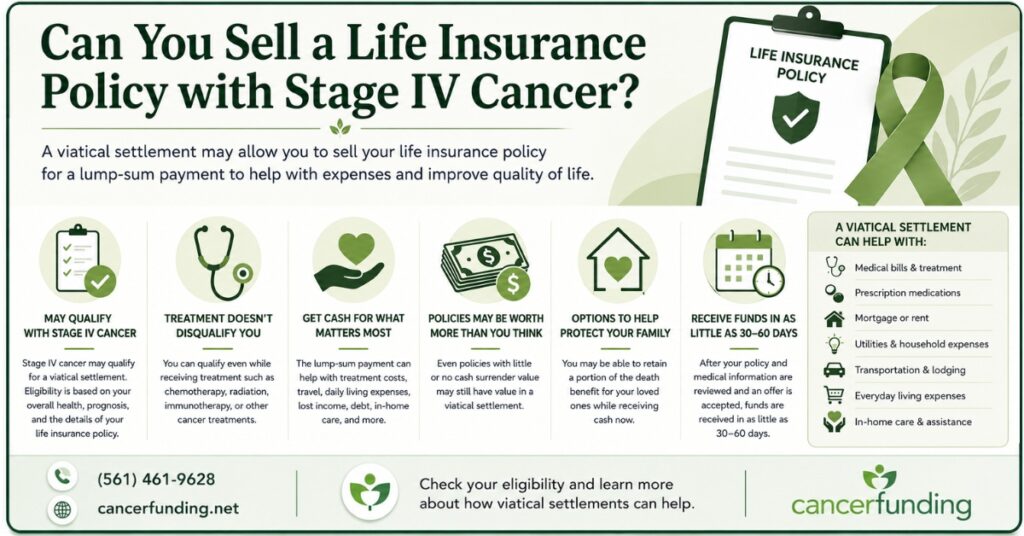
In many cases, the answer is yes. People with advanced cancer may qualify for a viatical settlement, which allows an eligible life insurance policy to be sold for a lump-sum cash payment that can help with treatment costs, household expenses, lost income, debt, or other financial needs.
Does Stage IV Cancer Qualify for a Viatical Settlement?
Stage IV cancer may qualify for a viatical settlement, but the cancer stage alone does not determine eligibility.
Stage IV generally means that cancer has spread beyond its original location to other parts of the body. However, prognosis can vary considerably depending on the type of cancer, where it has spread, available treatments, response to treatment, and the patient’s overall health.
For a viatical settlement, medical records are reviewed to evaluate the insured’s overall health and estimated life expectancy. The life insurance policy is evaluated separately to determine whether the coverage is eligible and what it may be worth.
This means two people with Stage IV cancer may receive very different evaluations even if they have similar life insurance policies.
Does Stage IV Cancer Mean You Are Terminally Ill?
Not necessarily. Stage IV and terminal cancer are not interchangeable terms.
Some Stage IV cancers can be managed for extended periods with chemotherapy, immunotherapy, targeted therapies, hormone therapy, radiation, surgery, or a combination of treatments. Advances in cancer treatment have also changed the outlook for people with certain types of metastatic cancer.
For viatical settlement purposes, the important consideration is not simply whether a medical record says “Stage IV.” The insured’s individual prognosis and estimated life expectancy are considered along with the details of the life insurance policy.
You do not need to determine for yourself whether your diagnosis meets the requirements. A policy and medical review can determine whether you may qualify or financial counselor can help identify programs for which they may qualify.
Can You Qualify If Your Stage IV Cancer Is Responding to Treatment?
A positive response to treatment does not automatically mean that a life insurance policy cannot qualify for a viatical settlement.
Medical evaluations consider the complete picture. This may include the original diagnosis, extent of metastatic cancer, treatment history, current treatment, response to therapy, other medical conditions, and prognosis.
For example, someone whose cancer has responded to treatment may still have an advanced illness with a reduced life expectancy. Another person with the same stage and type of cancer may have a substantially different prognosis.
Because these situations are highly individual, it is generally not possible to determine viatical settlement eligibility from cancer stage or treatment response alone.
Can You Sell Your Life Insurance Policy While Receiving Cancer Treatment?
Yes. You do not have to stop cancer treatment to explore a viatical settlement.
Patients may be receiving chemotherapy, radiation, immunotherapy, targeted therapy, hormone therapy, or other treatments while their life insurance policy is being evaluated.
A viatical settlement is a financial transaction involving an existing life insurance policy. It does not require you to discontinue treatment or change your medical care.
This can be especially important for people with Stage IV cancer who are actively pursuing treatment but are experiencing financial pressure from medical expenses, travel, reduced income, or other costs associated with their illness.
What Types of Life Insurance Can You Sell with Stage IV Cancer?
Several types of life insurance may qualify for a viatical settlement, including whole life, universal life, and certain term life insurance policies.
Term policies often require additional consideration. If your term policy has an active conversion privilege, it may be possible to convert it into permanent coverage without new medical underwriting. Certain non-convertible term policies may also qualify when the insured has a terminal illness and limited life expectancy.
Importantly, a policy does not necessarily need to have significant cash surrender value to have value in a viatical settlement.
If you have term coverage and want a more detailed explanation of how these policies are evaluated, see our guide, Can you sell a term life insurance policy after a cancer diagnosis?
How Much Is a Life Insurance Policy Worth with Stage IV Cancer?
There is no set percentage or payout based solely on having Stage IV cancer.
The amount a policy may be worth depends on a combination of medical and policy factors, including:
- The policy’s death benefit
- The insured’s age
- Type and stage of cancer
- Overall health and prognosis
- Estimated life expectancy
- Current and future premium costs
- Type and structure of the policy
Because both the medical circumstances and policy details matter, two policies with identical death benefits may have very different settlement values.
An evaluation is necessary to determine whether a specific policy qualifies and how much it may be worth.
How Can a Viatical Settlement Help Someone with Stage IV Cancer?
For someone living with advanced cancer, financial needs often extend far beyond hospital bills.
Treatment may require frequent trips to an oncology center or travel to a specialized cancer facility. A patient may need help at home, modifications to make the home more accessible, or additional transportation. Cancer can also affect the ability of both patients and caregivers to continue working their usual schedules.
Viatical settlement proceeds can generally be used for any purpose, which means the funds may help with expenses such as:
- Cancer treatment and medical bills
- Prescription medications
- Travel and lodging for specialized care
- Mortgage or rent payments
- Utilities and groceries
- In-home care or assistance
- Transportation
- Paying down debt
- Replacing income lost during treatment
- Spending meaningful time with family
For many families, having access to money now can provide financial flexibility at a time when it is needed most.
Can You Keep Part of the Death Benefit for Your Family?
Selling a life insurance policy generally means that the buyer becomes the policy’s owner and beneficiary. However, giving up the entire death benefit is not always the only possibility.
In some cases, a retained death benefit may be available. This arrangement can allow the policy owner to receive money from the policy while preserving a portion of the death benefit for beneficiaries.
This can be worth exploring for someone who needs financial relief now but would also like to leave some life insurance benefits to family members. Typically, larger policies ($500,000 or more) are the most likely to qualify for this option.
How Long Does It Take to Receive Money from a Viatical Settlement?
A viatical settlement can take as little as 30 to 60 days, although every case is different. Obtaining medical records and information from the life insurance company can have a significant effect on the timeline.
Once the policy and medical information have been reviewed, an offer can be made if the policy qualifies. If the offer is accepted, closing documents are completed before the settlement funds are released.
How Do You Find Out If Your Life Insurance Policy Qualifies?
You do not need to know whether your cancer is considered terminal, calculate your own life expectancy, or determine whether your particular type of life insurance can be sold before requesting an evaluation.
If you have Stage IV cancer and an existing life insurance policy, the first step is simply to have the policy and your medical circumstances reviewed. The evaluation can determine whether your policy may qualify and, if it does, how much you may be able to receive.
Even a policy with little or no cash surrender value may have settlement value. Finding out what your policy may be worth can give you another financial resource to consider while deciding what makes the most sense for you and your family.
For someone living with Stage IV cancer, accessing the value of life insurance while still living can provide financial relief when it may matter most, helping with treatment, everyday expenses, and the ability to focus more fully on health and quality of life.
To learn if you may qualify for a viatical settlement to help with expenses, please reach out to Settlement Group, a licensed life settlement provider at 754-296-9034, email inquiries@settlementgroup.io, or visit settlementgroup.io.