If you are living with cancer or another serious illness, you may be looking at your life insurance policy differently than you did when you first purchased it. How to decide whether a viatical settlement is right for you depends on your current financial needs, the value of your policy, the needs of your beneficiaries, and what you want the policy to accomplish now. A viatical settlement allows you to sell a life insurance policy for a lump-sum cash payment that can be used for medical expenses, living costs, debt, caregiving, or any other purpose.
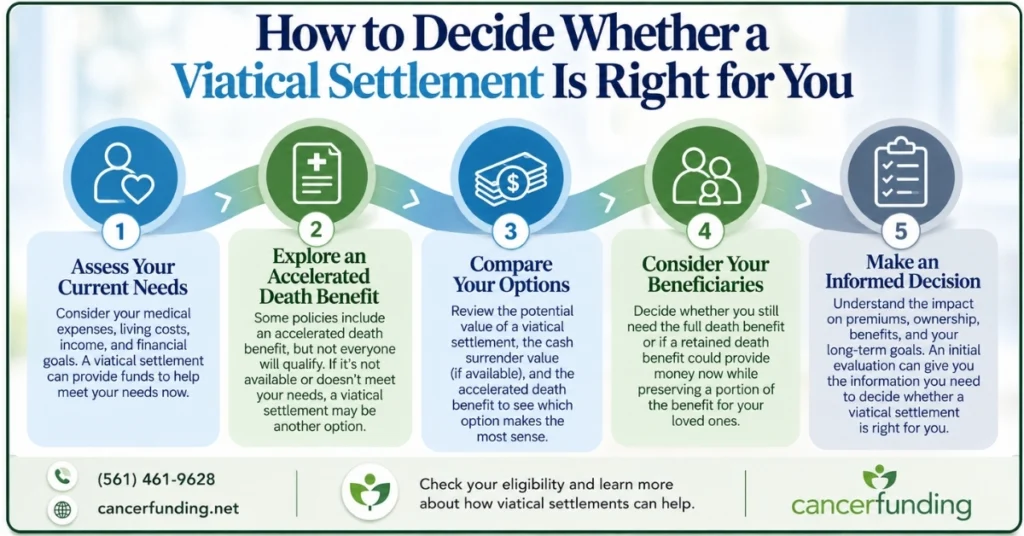
Selling a policy is an important financial decision, but it is not the only way to access value from life insurance. Depending on your policy and circumstances, you may also be able to use an accelerated death benefit, surrender the policy, or keep some of the death benefit for your beneficiaries. Understanding these options can help you decide which approach makes the most sense for you.
Why Are You Considering Selling Your Life Insurance Policy?
Start with the reason you are considering a viatical settlement. A life insurance policy is designed to provide a benefit in the future, but a serious illness can create financial needs in the present.
You may be facing medical expenses that insurance does not fully cover, reduced income because you or a family member cannot work, travel costs for treatment, home care expenses, or everyday bills. You may also want greater financial flexibility to spend time with family, make changes to your living situation, or simply reduce financial stress.
A viatical settlement converts an existing asset into money you can use now. There are no restrictions imposed by the settlement provider on how you use the proceeds, allowing you to decide where the money is most useful.
Do You Still Need the Full Life Insurance Death Benefit?
Consider whether your beneficiaries still need the entire death benefit. Your circumstances may have changed considerably since you purchased the policy. Children may now be financially independent, debts may have been paid, or the original reason for carrying the policy may no longer exist.
If leaving the full death benefit is still a priority, keeping the policy may make more sense. Selling the policy does not always have to mean giving up the entire death benefit, however. Depending on the policy and transaction, a retained death benefit may allow you to receive money from a settlement while preserving a portion of the policy’s death benefit for your beneficiaries.
Looking at both your present financial needs and what you want to leave behind can help you determine how much value you need from the policy today.
Could You Use an Accelerated Death Benefit Instead?
Some life insurance policies include an accelerated death benefit that allows the policy owner to access a portion of the death benefit while the insured is still living. If this benefit is available and you qualify, it may provide money during a serious illness without selling the policy to a third party.
Not everyone with an accelerated death benefit rider will qualify to use it. The insurance company establishes the eligibility requirements, which can include specific medical conditions or life expectancy requirements.
If you do not qualify for an accelerated death benefit, a viatical settlement may still be an option. Eligibility for a viatical settlement is determined separately, so not meeting an insurance company’s requirements for an accelerated death benefit does not necessarily mean the policy cannot qualify for a settlement.
Is Keeping the Policy Becoming Too Expensive?
The cost of maintaining the policy is another important consideration. Premiums that were once manageable can become burdensome when income decreases or medical and household expenses increase.
With a viatical settlement, the buyer becomes responsible for future premiums after the transaction is completed. You receive the agreed-upon settlement proceeds and no longer have to budget for those payments.
If you are considering allowing a policy to lapse because of its premiums, it can be worthwhile to determine whether it has value through a viatical settlement before stopping payments. A lapse will eliminate the opportunity to receive value from the policy.
How Does a Viatical Settlement Compare with Surrendering Your Policy?
If you have permanent life insurance, your insurance company may offer a cash surrender value if you cancel the policy. A viatical settlement is different because the policy is sold rather than surrendered to the insurance company.
A viatical settlement provides more than the policy’s cash surrender value but less than its death benefit. The amount depends on factors that include the death benefit, future premiums, the insured’s health and estimated life expectancy, and the terms of the policy. Typically, you receive exponentially more than the cash surrender value.
Term life insurance does not have a cash surrender value, but certain term policies can still qualify for a viatical settlement, particularly when they can be converted to permanent insurance. This means a policy with little or no surrender value may still have value in the secondary market.
Could a Viatical Settlement Affect Your Benefits?
A viatical settlement can affect eligibility for certain needs-based government benefits.
Medicare eligibility is not based on income or assets, so receiving viatical settlement proceeds does not by itself make someone ineligible for Medicare. Medicaid, Supplemental Security Income (SSI), and other needs-based programs have financial eligibility requirements, and receiving settlement proceeds can affect eligibility depending on the program and the individual’s circumstances.
If you receive needs-based benefits, understanding how settlement proceeds may affect those benefits should be part of your decision before completing the transaction.
Do You Know What Your Life Insurance Policy May Be Worth?
You do not have to decide to sell your policy before finding out whether it qualifies or what it may be worth. An initial viatical settlement evaluation can give you an idea of your policy’s value.
The evaluation looks at factors such as the policy’s death benefit, future premium requirements, policy terms, and the insured’s health and estimated life expectancy. Medical records and policy information are reviewed as part of the process.
Once you know whether the policy qualifies and what a potential settlement could provide, you can compare that option with keeping the policy, using an accelerated death benefit if available, surrendering the policy, or considering a retained death benefit.
How Do You Decide Whether a Viatical Settlement Is Right for You?
There is no single answer that applies to every policy owner. Consider what you need from your life insurance policy today as well as what you want it to provide in the future.
If you need access to money now, find out whether an accelerated death benefit is available and whether you qualify. If it is not available, you do not qualify, or it does not provide the amount you need, a viatical settlement may offer another way to access the value of your policy. If you are considering surrendering or lapsing the policy, finding out whether it has settlement value can also give you another option before giving up the policy.
At the same time, consider the importance of the death benefit to your beneficiaries, the cost of continuing the policy, the amount you could receive from a settlement, and whether the proceeds could have a Medicaid impact. A retained death benefit may also be worth exploring if you want access to money now while preserving a portion of the death benefit.
You do not have to commit to selling your policy simply to find out whether it qualifies. An initial evaluation can help you understand what your policy may be worth so you can make the decision with more complete information.
To learn if you may qualify for a viatical settlement to help with expenses, please reach out to Settlement Group, a licensed life settlement provider at 754-296-9034, email inquiries@settlementgroup.io, or visit settlementgroup.io.